Welcome to my Supra page

Boost Gauge and EVC Installation
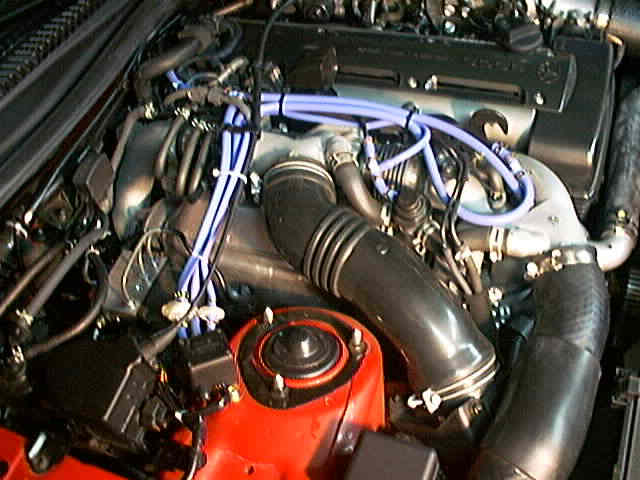
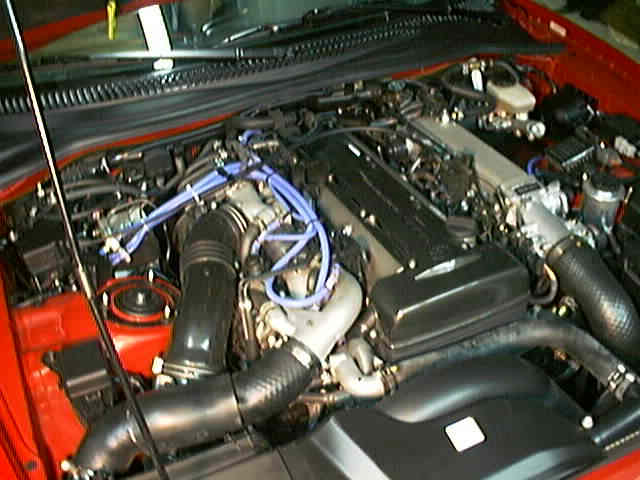
Here are some pictures of the boost gauge that I have installed in teh clock location. If you click on the picture to get a larger view you will see that it matches the stock gauges quite well. I also included some shots of the EVC installation and how the hoes are routed. I wil soon include the installation instructions that were left out of the HKS manual.
|
|
|
|
|
|
My Car
Here are some pictures of my new 1997 Supra (Production #286).


 |
 |
My Car at the Meet |
No, I would never go that fast its not legal --->

Both this Supra and its forebear are powered by a turbocharged three-litre 24-valve straight six, but that is the length, breadth and depth of their common ground. The new car actually has a fractionally larger capacity of 2997cc (up from 2954cc) and two turbos acting sequentially, like those fitted to the Mazda RX-7. And its power is quite beyond anything we have yet seen in this class.
This engine liberates 326bhp at 5600rpm and an indomitable 325lb ft of torque at 480Orpm, which is fed through a six-speed Getrag gearbox and Torsen differential before reaching the rear wheels of a car that is actually lighter than the old Supra. With a power-toweight ratio of 210bhp per tonne (compared with the 149bhp per tonne of old), then-and-now performance comparisons serve only to speak ill of the dead.
Now its impressive urge below 4000rpm is simply a warm-up act, setting the scene for the arrival of the second turbo. You can hear it coming - a high-frequency whistle spearing out of the pleasant but unremarkable straight six hum, followed by snap acceleration that straightens your right arm and sends the left scurrying after the next ratio.
Getrag developed the sixspeed 'box in conjunction with Toyota, and its heavy mechanical feel, precision and super-short throws mean you never have to worry whether the next gear will engage smoothly or not. Slam the lever in the desired direction and, so long as the clutch is fully depressed, acceleration remains furious until you reach sixth. That the rate slows in top is no hardship, especially as you don't need to select it until you reach the far side of 150mph. Despite the fact that sixth is rated at 28.1 mph per 1000rpm, the Supra still reaches the legal limit from 50mph before all its rivals bar the preposterously fast (and 20 per cent shorter geared) BMW M3.
Turn your attention to all-out acceleration and the figures say that this swiftest of all vaguely affordable coupes is, in fact, a genuine front-engined supercar: you simply cannot argue with times of 0-60mph in 5. 1 see, 0-,100mph in 12.3sec and 30-70mph in 4.7sec. Who would have thought it of a Toyota Supra?
Only its top speed fails to grab the front page: its electronically limited maximum of 156mph is exactly par for the class course. Without its restraining order, Toyota intimates something closer to 180mph is feasible.
There is, however, disappointment in this engine. just as it's true that it splits its personalities either side of 4000rpm, it is also an inescapable fact that performance is delivered with insufficient immediacy if you allow the revcounter needle to fall far below 3000rpm. While this might be explained away as an occupational hazard of a turbo engine pushing out 109bhp for every litre, it remains a poor substitute for the throttle response of a similarly powerful but larger and normally aspirated V8. Its sound, too, contrives to blunt the edge of your driving enjoyment; while the engine remains smooth and utterly unruffled even at its 7100rpm cut-out point, it is unable to offer its driver the merest aural stimulation to match its massive power output.

Nothing less than the wheel control afforded by double wishbones at each corner was good enough for Toyota's chassis engineers, while state-of-the-art Michelin Pilot tyres of 255140 section at the rear and 235145 up front are fitted to the I7in light alloy rims. And as anyone who read our annual feature on Britain's best-handling cars (11 August) will know, the Supra has heroic levels of grip. The tyres deserve at least part of the credit for this, although they are not, in fact, particularly wide in comparison with the class norm. The remainder; of the praise should be heaped, in piles on both the car's structure, which provides exceptional rigidity, and the suspension, which builds on this foundation to provide, a level of body control that we have not seen in this class or any other below that of the very fastest and most expensive supercars. What this means in real terms is that no obstacle you are likely to encounter in the course of a cross-country blast should interfere with the tyres' purchase on the road. Hit a ridge or bump halfway around a corner and while you may hear a slight thump from the suspension, you are unlikely. to feel so much as a shimmy from the tyres. Similarly, take to a violently undulating and broken road - one that would force most fast cars to shed speed to save the stomachs of those on board - and the Supra will rocket along, as unperturbed as a hovercraft on a logoon. Yet as they did with engine, Toyota's engineers, in their noble quest to create a chassis of peerless ability, have left the door open for other, technically less capable rivals to provide the driver with the real fun and, as a result, a potentially richer driving experience. You should not doubt how quickly a Porsche 968 or a Nissan 3OOZX would shrink in the mirror of a fast-driven Supra, but nor should you be surprised to see the Porsche and Nissan drivers wearing the larger smiles at the end of the road. It's essentially the fault of the steering, which, while well weighted, precise and sensibly geared at 2.8 turns across the locks, lacks sufficient feedback and often makes you feel like you're wearing thick mittens as you drive. The information telegraphed to your backside comes similarly padded. These communications would not be missed quite so much if the Supra had nothing more to offer the driver than sheer grip. But when it dawns on you that beyond the tyres' limits (artificially enforced by a mercifully switchable traction control system) lies a land from where understeer has been exiled to make room for neutral handling and safe powerslides, the omission of this final pleasure is particularly missed.